
5 key areas for increasing social media engagement
- Social media


It is no secret that social media has changed user behaviour, including during crises. Information spreads faster, making timely responses and updates essential. This is where crisis management comes in, as we explain below.
Crisis management is a process designed to prevent or minimise the damage a crisis can cause to a brand and its shareholders. A crisis is an unexpected event that can potentially have a negative impact on business.
Crisis management is divided into three phases:
The pre-crisis phase includes creating a crisis management plan and training the crisis management team. These steps will help when a crisis or emergency actually occurs. During the crisis, your plan is put into action. You prepare and issue initial statements and posts, and contact employees, partners and the public. Once the crisis subsides or ends, your work is only beginning. It is important to stay in touch with employees, partners and the public, remaining available for questions. Remember to update your website proactively or share information through other channels. Beyond providing updates, review your crisis management plan and how it worked in practice. How did you respond? Did you answer every question? What needs improvement? Incorporate all these findings into a new crisis management plan.
The pre-crisis phase includes creating a crisis management plan and training the crisis management team. These steps will help when a crisis or emergency actually occurs.
Crisis communication through social media has several advantages. One is that those affected can quickly share relevant information through their own channels. Social media also allows us to monitor users’ reactions and behaviour.
Social media can play two roles in crisis communication:
Absent or poor social media communication can itself trigger a crisis. In this case, silence is not golden: it is a catalyst. Used correctly, social media becomes a valuable tool for containing a crisis. During a crisis, social media is used to emphasise key messages, monitor reactions and listen to users’ questions. Although we do not recommend it as the only communication channel during a crisis, it must not be overlooked.
We have already mentioned the crisis management plan, which must also include social media protocols. Here are some of the most important points its social media section should cover:
Pause all scheduled posts
All plans, proposals and campaigns should be paused immediately. However good the creative work, campaign or results may be, this is not the time — especially if they contain a claim inappropriate to the situation.
Coordinate your response
Every team member should know their responsibilities and deadlines. In crisis communication especially, everyone needs to know what is expected and when. Make sure they get proper breaks and rest, delegate tasks and help one another wherever possible.
Watch your tone
Every post and statement must be informative and use a calm tone.
Be honest
Whether the crisis is global or internal, be honest. Address the problem in your statement, status update, news item or post, and explain the methods, processes or strategies you are using to resolve it. A lie has far greater reach and impact, and causes more damage than the problem you are currently facing.
Communicate with users and answer their questions
By using social media effectively and implementing Social Listening tools, you can stay two steps ahead and answer your audience’s questions. Do not guess what interests them — listen.
Stay up to date
If the problem or crisis you are facing continues over time, keep users regularly updated on every step you take.
Do not disappear
Ignoring a problem does not make it disappear. The only thing that will disappear is your brand’s good reputation.
A good community manager does more than half the work
A community manager is one of the most important people during a crisis. A calm, objective and timely response contributes to more effective crisis communication. A community manager also listens to the community, providing valuable guidance when those insights are used correctly. With their help, you can answer questions and improve your communication. Generic or delayed answers, slow responses, and hiding or deleting comments only add fuel to the fire.
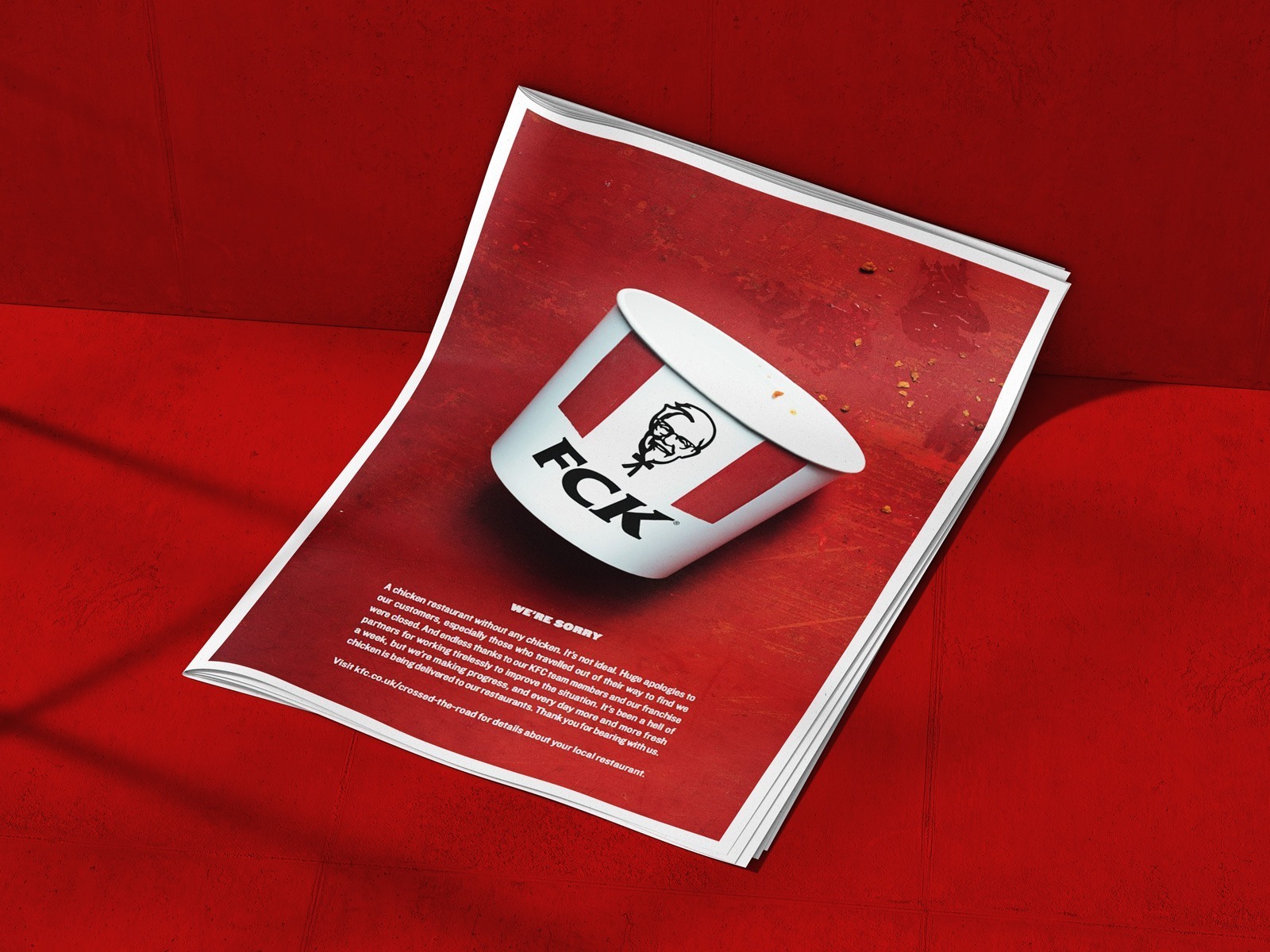
What happens when a world-famous fast-food chain runs out of its main ingredient, chicken? That is exactly what happened to KFC, which ran out of chicken at almost all its restaurants across the UK and Ireland. A chain of unforeseen events caused logistical problems. Public criticism was widespread, and the marketing team got to work on a campaign to apologise to customers.
The We’re Sorry campaign led to a website where customers could check chicken availability at local restaurants, while customer enquiries were addressed promptly every day.
The We’re Sorry campaign led to a website where customers could check chicken availability at local restaurants, while customer enquiries were addressed promptly every day. The creative execution was just as effective, with FCK as the campaign’s central message. An authentic, humorous and swift response generated positive reactions from the public and customers. Attention shifted from the problem to the response and solution, which delivered results and built trust in the brand.
In a crisis, respond quickly, but not without a strategy. Use social media to convey your message, adapting it to your audience and the platform. Keep corporate messaging and official statements for your website and the media.
We have already mentioned how social media has changed consumer behaviour. Likes, tags and trends emerged. Tide, the world-famous laundry detergent manufacturer, knows this all too well. In 2017, the Tide Pod Challenge appeared on YouTube, leading to more than 200 teenagers being hospitalised. The ‘challenge’ involved eating a Tide laundry detergent capsule.
In response to the ‘challenge’, Tide launched a campaign with Rob Gronkowski in early 2018 to stop this dangerous trend. This textbook example of effective crisis communication used an influential person’s voice and reach to spread the message.
In 2009, the American pizza chain Domino’s Pizza faced a crisis caused by its own employees. A series of videos posted on YouTube showed two employees joking around in the kitchen of one of its branches. One employee filmed a colleague performing various unhygienic stunts, such as putting shredded cheese up his nose before returning it to a customer’s order and sneezing on another food order. The food was then sent out for delivery, and the video was posted online.
The videos quickly went viral, bringing the incident to management’s attention. The company’s vice-president addressed the issue, apologised and thanked the public for helping bring it to light. President Patrick Doyle also responded with a two-minute YouTube video explaining the next steps and the measures being taken to prevent a recurrence. He said the North Carolina store where the videos were filmed had been closed and sanitised. Domino’s would review its hiring practices, and the franchise owner filed criminal charges against the two employees, who were dismissed immediately after the videos appeared.
Domino’s Pizza worked hard to rebuild trust and protect its brand during this crisis, using transparency, consistency, authenticity and visibility to safeguard its reputation.
In July 2015, the well-known fast-food chain Chipotle experienced an E. coli outbreak that lasted until January 2016. It spread across the United States, causing an 82% drop in annual profit and a 15% fall in its share price. Further turmoil followed the arrest of a senior figure for cocaine possession, while 10,000 employees sued the company over unpaid compensation.
The (crisis) communication was poor and drew widespread public criticism. When he finally spoke out, director Monty Moran said: “Given that the media love sensational headlines, you will probably see a headline saying ‘Oh, that’s Chipotle’s E. coli’ whenever someone sneezes for a while.” A few days later, Chipotle’s founder publicly apologised and promised to introduce procedures exceeding industry standards, making it the safest place to eat. Following the apology, shares rose by 5%.
Today, Chipotle has made a significant comeback. But it owes that recovery to a new director, who spent years and millions of dollars rebuilding trust in the brand.
Airlines frequently face minor social media crises. On this occasion, budget airline Ryanair came under fire after a social media video showed a man directing racist abuse at another passenger on one of its flights. The crew also drew anger after telling the man to ‘calm down’ and moving the victim, an elderly woman, to another seat. The video was viewed more than 7.6 million times, generating damaging headlines and calls for a boycott on social media. Ryanair’s late, brief response was: ‘We are aware of this video and have reported the matter to Essex Police.’
After a week of negative headlines and public reactions, Ryanair finally issued a more detailed public statement. The company’s response was generic and blamed the media for ‘misreporting’ the situation. It failed to resonate with the public, and the company did not apologise for what had happened.
The pizza chain Papa John’s faced a genuine ‘PR nightmare’ when its founder and chairman, John Schnatter, resigned after using a racist slur during a conference call. His resignation raised an awkward PR question: how do you rebrand Papa John’s when the problem is Papa John? One approach the company chose was an apology advert, a tactic that became increasingly popular during incidents in 2018.
The only problem with this approach was that the video contained neither an actual apology nor any explanation of what the company planned to do to prevent something similar happening again. This sparked another backlash. Sales plummeted, and founder John Schnatter refused to leave quietly. He created the Save Papa John’s website to challenge the board, which had tried to ‘silence’ him. He eventually stepped down, leaving the company facing major problems and challenges.
Social Wizard is a full-service digital agency with over 10 years of experience. Our experts are available to help plan and implement your crisis communication. Get in touch with confidence!